![[ANSYS, Inc. Logo]](fluentlogo.gif)


|
|
|
Over the last decade, the proton exchange membrane fuel cell (PEMFC) has emerged as a favored technology for auto transportation and power generation because it is compact, clean, runs at low temperature (
 100
100
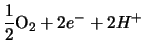
 C), permits an adjustable power output, and can be started relatively rapidly. Hydrogen is supplied at the anode and air is supplied at the cathode. The following electrochemical reactions take place in the anode and cathode triple phase boundary (TPB) layers, respectively,
Electrons produced in the anode travel through an external circuit to the cathode, while protons (
 ) travel through the membrane from the anode TPB to the cathode TPB, thus forming an electrical circuit.
As more and more water is generated at the cathode, due to both osmotic drag and electrochemical reactions, water vapor pressure exceeds saturation pressure forming liquid water. The formation and transport of liquid water in the cathode is an important feature that can strongly influence cell performance of a PEMFC.
Previous:
1.1 Introduction