![[ANSYS, Inc. Logo]](fluentlogo.gif)


|
|
|
For an incompressible flow, the energy equation that ANSYS FLUENT solves for within each computational cell is given by the following:
where
 is the volumetric source or sink of energy and where
 |
(3.4-21) |
and
In all electrically conducting zones (e.g., electrodes, current collectors, interconnects), ohmic heating,
 , is added to the energy equation as a source term. In other words,
 |
(3.4-23) |
In addition, the energy equation needs treatment at the electrode-electrolyte interface to account for the heat generated or lost as the result of electrochemistry and the overpotentials (i.e., activation overpotential and ohmic loss through the electrolyte).
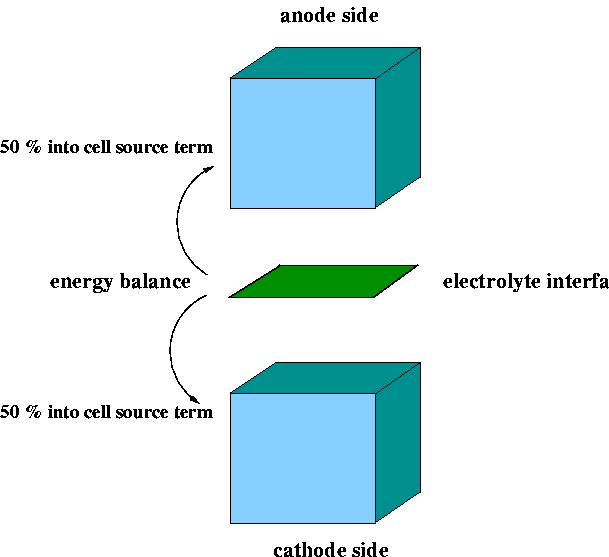
The total energy balance on the electrolyte interface is computed by enumerating the enthalpy flux of all species, including the heat of formation (sources of chemical energy entering the system), and then subtracting off the work done (leaving the system) which is simply the local voltage jump multiplied by the local current density. What remains is the waste heat due to irreversibilities. For hydrogen reaction, the balance would be
 |
(3.4-24) |
where
 is the heat generation (W) and
 is the total enthalpy of species (J/s) composed of the sensible enthalpy in addition to the enthalpy of formation.
The heat of formation is
![h_{H2} = \dot{m}_{H2} [\int_{T_{ref}}^T C_pdT + h_0]](img415.gif) |
(3.4-25) |
The source term is then added in the cell energy equation by taking
 .
.
One half of this value is applied as a source term to the energy equation of the anode computational cell adjacent to the electrolyte and the other half is applied as a source term to the energy equation for the cathode cell adjacent to the electrolyte. The equal distribution of the heat generation/destruction is purely arbitrary. Note that by using the work term, the effect from all overpotentials are taken into account.
Previous:
3.4.2 Activation Overpotential