![[ANSYS, Inc. Logo]](fluentlogo.gif)


|
|
|
The sinusoidal form of the magnetic field is defined as:
where
 is the mean vector,
 is the amplitude vector,
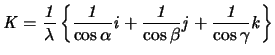
 is defined as the propagation vector,
 is the position vector of an arbitrary point.
 ,
,
 and
and
 are the
 ,
,
 and
and
 direction cosines respectively. The quantities
 ,
,
 , and
, and
 are the frequency, wavelength, and phase offset, respectively. For a non-moving field the propagation vector is zero. For a static field only applies.
The square form of the magnetic field is defined as:
The definition of the propagation vector is the same as for the sinusoidal form.
Previous:
B. Definitions of the