![[ANSYS, Inc. Logo]](fluentlogo.gif)


|
|
|
The particle state vector is characterized by a set of "external coordinates'' (
 ), which denote the spatial position of the particle, and "internal coordinates'' (
 ), which could include particle size, composition, and temperature. From these coordinates, a number density function
 can be postulated where
 ,
,
 . Therefore, the average number of particles in the infinitesimal volume
 is
is
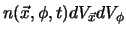 . In contrast, the continuous phase state vector is given by
![${\vec Y}\equiv [Y_1({\vec x},t),Y_2({\vec x},t),\ldots,Y_c({\vec x},t)]$](img36.gif)
The total number of particles in the entire system is then
 |
(2.1-1) |
The local average number density in physical space (i.e., the total number of particles per unit volume) is given by
 |
(2.1-2) |
The total volume fraction of all particles is given by
 |
(2.1-3) |
where
 is the volume of a particle in state
 .
.
Previous:
2. Population Balance Model