![[ANSYS, Inc. Logo]](fluentlogo.gif)


|
|
|
The following options for drag coefficients are available in the fiber model to compute the drag due to flow moving parallel to the fibers:
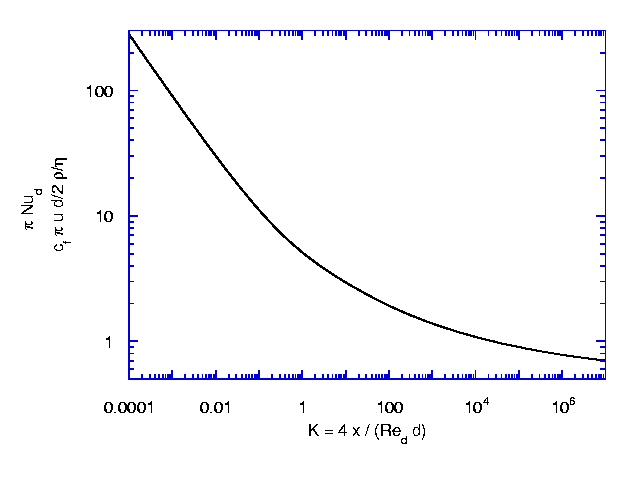
Gampert provided analytical and numerical solutions for laminar axisymmetric flow of a moving cylinder in stationary air including strong curvature effects in the boundary layer, [
2]. The drag coefficient and the Nusselt number are shown as dimensionless groups in Figure
2.8.1. Note that the curvature
 is defined as the abscissa in Figure
2.8.1. This correlation is recommended in laminar flows.
is defined as the abscissa in Figure
2.8.1. This correlation is recommended in laminar flows.
In Figure
2.8.1 and Equation
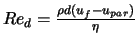
2.8-1, the Reynolds number is computed based on the relative velocity of the surrounding flow parallel to the fibers
 .
.
Lateral drag due to flow of the surrounding fluid perpendicular to the fibers is computed by a correlation from Schlichting [ 7]
In Equation
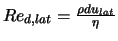
2.8-2 the Reynolds number is computed based on the relative velocity of the surrounding flow perpendicular to the fibers
 .
.
Previous:
2.8 Correlations for Momentum,