![[ANSYS, Inc. Logo]](fluentlogo.gif)


|
|
|
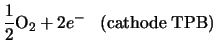
There has been an increasingly strong need for the large-scale production of hydrogen as a secondary energy carrier for the non-electrical market (such as PEMFC and SOFC applications). One of the cleaner and more efficient methods of producing hydrogen is to use high-temperature electrolysis to split water molecules. Therefore, electrolysis is essentially a reversed fuel cell process. Power is supplied to an electrolyzer to convert water vapor into hydrogen and oxygen. Water vapor is fed through the anode electrodes to the active electrolyte region. Once power is supplied to the anode electrode, the following electrochemical reactions take place:
In electrolysis, the activation overpotentials have the opposite sign of what is used in fuel cells. This means that the cell voltage is higher than the open circuit voltage, since power is added to overcome the activation overpotentials. The ionic conductivity in the electrolyte is typically a function of temperature, such as in the case of SOFC. And it is pointed out here that, for an electrolyzer, high thermodynamic efficiency can be achieved only at a high operating temperature (
 500
500
 C). Because of this, the flow field is in vapor phase only and is handled as such within
ANSYS FLUENT.
C). Because of this, the flow field is in vapor phase only and is handled as such within
ANSYS FLUENT.
Previous:
1.1.2 Introduction to SOFC