![[ANSYS, Inc. Logo]](fluentlogo.gif)


|
|
|
Gas phase species diffusivities can be computed either by using the dilute approximation method or by using the full multicomponent method. With the dilute approximation method, we have
where
 is the mass diffusivity of species
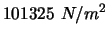
 at reference temperature and pressure (
 ,
,
 ) [
9]. These reference values and the exponents (
) [
9]. These reference values and the exponents (
 ) as well as the exponent of pore blockage (
 ) are defined in the Fuel Cell and Electrolysis user defined functions (UDF) as,
In addition to Equation 1.6-1, the ANSYS FLUENT Fuel Cell and Electrolysis Model also contains a method to compute the gas phase species diffusion (a full multicomponent diffusion method with corrections to account for the porous media tortuosity):
where
 is the effective gas species diffusivity,
 is the porosity of the porous medium, and
 is the gas species mass diffusivity computed by the full multicomponent diffusion method as described in the Full Multicomponent Diffusion section of the Physical Properties chapter in the
ANSYS FLUENT User's Guide. Please note that
is the gas species mass diffusivity computed by the full multicomponent diffusion method as described in the Full Multicomponent Diffusion section of the Physical Properties chapter in the
ANSYS FLUENT User's Guide. Please note that
 in Equation
1.6-2 is used to model the effect of tortuosity. While this is implemented as the default method in the Fuel Cell and Electrolysis Model, you can overwrite it with your own correction methods by using the user-modifiable routines that are provided.
in Equation
1.6-2 is used to model the effect of tortuosity. While this is implemented as the default method in the Fuel Cell and Electrolysis Model, you can overwrite it with your own correction methods by using the user-modifiable routines that are provided.
Properties such as electrolyte phase electrical conductivity, water diffusivity, and the osmotic drag coefficient are evaluated as functions of the water content, using various correlations as suggested by [ 8]. To capture the relevant physics of the problem, various properties of the membrane are incorporated into the model as default options. You can, however, directly incorporate your own formulations and data for these properties by editing the functions defined in the provided source code file called pem_user.c and compiling the code yourself. For more information, see Section 2.11.
For SOFC and high-temperature Electrolysis, the ionic conductivity in the electrolyte is modeled as a function of temperature, and, by default, is defined as:
This is valid for temperatures ranging from 1073 K to 1373 K. You can implement your own models in the user-customizable UDF function
Electrolyte_Conductivity in
pem_user.c.
For PEMFC, the electrolyte (also called the membrane) phase conductivity is modeled as:
where
 is the water content. Two model constants,
 and
and
 are introduced in
ANSYS FLUENT for generality. Equation
1.6-4 becomes the original correlation from [
8] when
are introduced in
ANSYS FLUENT for generality. Equation
1.6-4 becomes the original correlation from [
8] when
 .
.
where
 and
and
 are the density and the equivalent weight of the dry membrane, respectively.
The water content,
 , that appears in the preceding property computations are obtained using Springer et al's correlation [
8],
, that appears in the preceding property computations are obtained using Springer et al's correlation [
8],
here
 is the water activity that is defined as,
The water vapor pressure is computed based upon the vapor molar fraction and the local pressure,
The saturation pressure is calculated, in terms of
 , as,
, as,
It is noted here that in [
8], water activity is defined on the basis of total water or super-saturated water vapor. With phase change being invoked in the present two-phase model,
 is added to the original formulation as suggested by [
2].
is added to the original formulation as suggested by [
2].
Previous:
1.5 Liquid Water Formation,