![[ANSYS, Inc. Logo]](fluentlogo.gif)


|
|
|
The following terms are defined in this glossary:
adaption
A technique useful in improving overall mesh quality. The solution-adaptive mesh refinement feature of ANSYS FLUENT allows you to refine and/or coarsen your mesh based on geometric and numerical solution data. In addition, ANSYS FLUENT provides tools for creating and viewing adaption fields customized to particular applications.
case files
Files that contain the mesh, boundary conditions, and solution parameters for a problem. A case file also contains the information about the user interface and graphics environment.
cell types
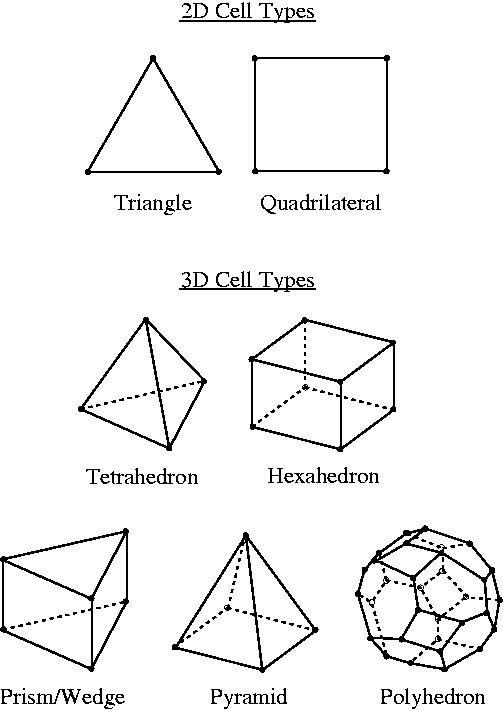
The various shapes or units that constitute the base elements of a mesh. ANSYS FLUENT can use meshes comprised of tetrahedral, hexahedral, pyramid, wedge, or polyhedral cells (or a combination of these).
computational fluid dynamics (CFD)
The science of predicting fluid flow, heat transfer, mass transfer (as in perspiration or dissolution), phase change (as in freezing or boiling), chemical reaction (e.g., combustion), mechanical movement (e.g., fan rotation), stress or deformation of related solid structures (such as a mast bending in the wind), and related phenomena by solving the mathematical equations that govern these processes using a numerical algorithm on a computer.
console
The console is part of the ANSYS FLUENT application window that allows for text command input and the display of information.
convergence
The point at which the solution is no longer changing with each successive iteration. Convergence criteria, along with a reduction in residuals, also help in determining when a solution is complete. Convergence criteria are pre-set conditions on the residuals that indicate that a certain level of convergence has been achieved. If the residuals for all problem variables fall below the convergence criteria but are still in decline, the solution is still changing to a greater or lesser degree. A better indicator occurs when the residuals flatten in a traditional residual plot (of residual value vs. iteration). This point, sometimes referred to as convergence at the level of machine accuracy, takes time to reach, however, and may be beyond your needs. For this reason, alternative tools such as reports of forces, heat balances, or mass balances can be used instead.
cortex
A utility that manages ANSYS FLUENT's user interface and basic graphical functions.
data files
Files that contain the values of the flow field in each grid element and the convergence history (residuals) for that flow field.
dialog boxes
The separate windows that are used like forms to perform input tasks. Each dialog box is unique and employs various types of input controls that make up the form.
discretization
The act of replacing the differential equations that govern fluid flow with a set of algebraic equations that are solved at distinct points.
GUI
The graphical user interface, which consists of the main ANSYS FLUENT application window, dialog boxes, graphics windows, etc.
mesh
A collection of points representing the flow field, where the equations of fluid motion (and temperature, if relevant) are calculated.
models
Numerical algorithms that approximate physical phenomenon (e.g., turbulence).
node
The distinct points of a mesh at which the equations of fluid motion are solved.
postprocessing
The act of analyzing the numerical results of your CFD simulation using reports, integrals, and graphical analysis tools such as contour plots, animations, etc.
residuals
The small imbalance that is created during the course of the iterative solution algorithm. This imbalance in each cell is a small, non-zero value that, under normal circumstances, decreases as the solution progresses.
skewness
The difference between the shape of the cell and the shape of an equilateral cell of equivalent volume. Highly skewed cells can decrease accuracy and destabilize the solution.
solvers
ANSYS FLUENT has two distinct solvers, based on numerical precision (single-precision vs. double-precision). Within each of these categories, there are solver formulations: pressure based; density based explicit; and density based implicit.
terminal emulator
See console.
TUI
The text user interface, which consists of textual commands that can be entered into the terminal emulator.
Previous:
A. Glossary of Terms