![[ANSYS, Inc. Logo]](fluentlogo.gif)


|
|
|
ANSYS FLUENT is a state-of-the-art computer program for modeling fluid flow, heat transfer, and chemical reactions in complex geometries.
ANSYS FLUENT is written in the C computer language and makes full use of the flexibility and power offered by the language. Consequently, true dynamic memory allocation, efficient data structures, and flexible solver control are all possible. In addition, ANSYS FLUENT uses a client/server architecture, which allows it to run as separate simultaneous processes on client desktop workstations and powerful compute servers. This architecture allows for efficient execution, interactive control, and complete flexibility between different types of machines or operating systems.
ANSYS FLUENT provides complete mesh flexibility, including the ability to solve your flow problems using unstructured meshes that can be generated about complex geometries with relative ease. Supported mesh types include 2D triangular/quadrilateral, 3D tetrahedral/hexahedral/pyramid/wedge/polyhedral, and mixed (hybrid) meshes. ANSYS FLUENT also allows you to refine or coarsen your mesh based on the flow solution.
After a mesh has been read into ANSYS FLUENT, all remaining operations are performed within ANSYS FLUENT. These include setting boundary conditions, defining fluid properties, executing the solution, refining the mesh, and postprocessing and viewing the results.
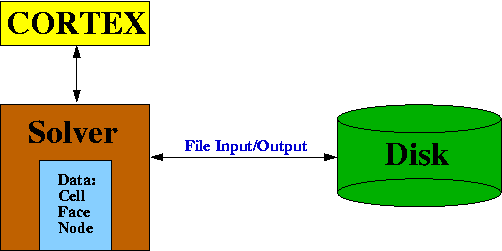
The ANSYS FLUENT serial solver manages file input and output, data storage, and flow field calculations using a single solver process on a single computer. ANSYS FLUENT also uses a utility called cortex that manages ANSYS FLUENT's user interface and basic graphical functions. ANSYS FLUENT's parallel solver allows you to compute a solution using multiple processes that may be executing on the same computer, or on different computers in a network.
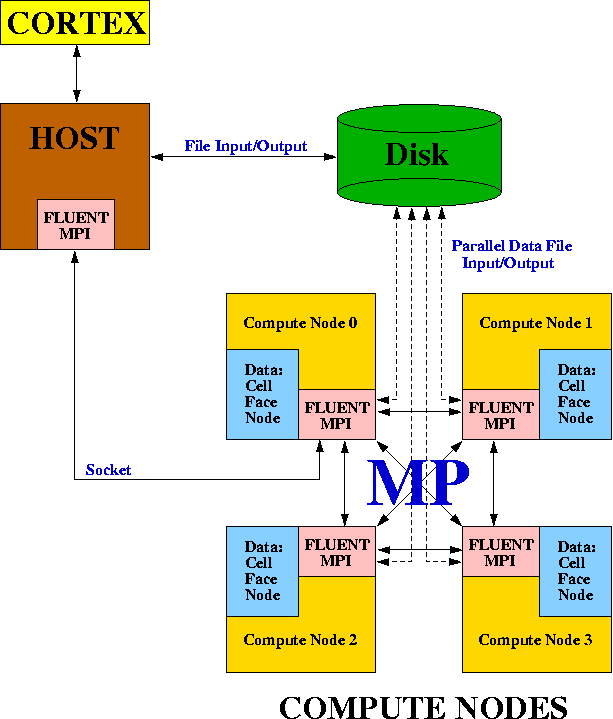
Parallel processing in ANSYS FLUENT involves an interaction between ANSYS FLUENT, a host process, and a set of compute-node processes. ANSYS FLUENT interacts with the host process and the collection of compute nodes using the cortex user interface utility.
Figures 1.0.1 and 1.0.2 illustrate the serial and parallel ANSYS FLUENT architectures.
For more information about ANSYS FLUENT's parallel processing capabilities, please refer to the User's Guide.
All functions required to compute a solution and display the results are accessible in ANSYS FLUENT through an interactive interface.
Previous:
Contacting Technical Support