![[ANSYS, Inc. Logo]](fluentlogo.gif)


|
|
|
 Generated in Conducting Media
 In this case the conditions given in Equations
2.2-6 and
2.2-7 are not true. Assuming that the electrical conductivity of the media in which field
 is generated is the same as that of the flow, i.e.
 , from Equations
2.2-3 and
2.2-5 the induction equation can be written as:
, from Equations
2.2-3 and
2.2-5 the induction equation can be written as:
and the current density is given by:
For the induction equation Equations 2.2-8 or 2.2-10, the boundary conditions for the induced field are given by:
where the subscripts denote the normal and tangential components of the field and
 is specified by the user. For an electrically insulating boundary, as
 at the boundary, from Ampere's relation one has
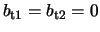 at the boundary.
Previous:
2.2.1 Case 1: Generated


