![[ANSYS, Inc. Logo]](fluentlogo.gif)


|
|
|
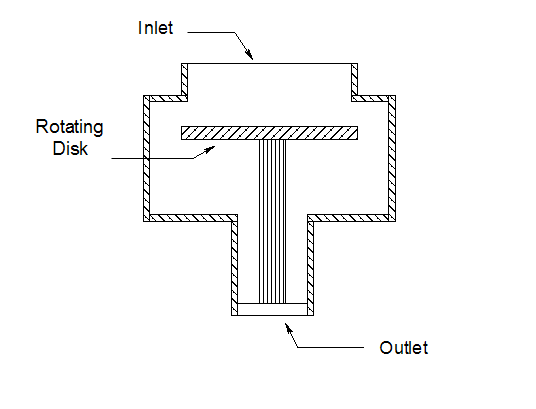
A rotating disk CVD reactor for the growth of Gallium Arsenide (GaAs) shown in Figure 16.1 will be modeled.
The process gases, Trimethyl Gallium (Ga
 ) and Arsine (AsH
 ) enter the reactor at 293 K through the inlet at the top. These gases flow over the hot, spinning disk depositing thin layers of gallium and arsenide on it in a uniform, repeatable manner. The disk rotation generates a radially pumping effect, which forces the gases to flow in a laminar manner down to the growth surface, outward across the disk, and finally to be discharged from the reactor.
The semiconductor materials Ga(s) and As(s) are deposited on the heated surface governed by the following surface reactions.
 |
(16.3-1) |
 |
(16.3-2) |
The inlet gas is a mixture of Trimethyl Gallium and Arsine and the mass fraction
of Ga
 is 0.15 and AsH
 is 0.4, respectively. The mixture velocity at the inlet is 0.02189 m/s. The disk rotates at 80 rad/sec. The top wall (wall-1) is heated to 473 K and the sidewalls (wall-2) of the reactor are maintained at 343 K. The susceptor (wall-4) is heated to a uniform temperature of 1023 K and the bottom wall (wall-6) is at 303 K. These CVD reactors are typically known as cold-wall reactors, where only the wafer surface is heated to higher temperatures, while the remaining reactor walls are maintained at low temperatures.
In this tutorial, simultaneous deposition of Ga and As is simulated and examined. The mixture properties and the mass diffusivity are determined based on kinetic theory. Detailed surface reactions with multiple sites and site species, and full multi-component/thermal diffusion effects are also included in the simulation.
The purpose of this tutorial is to demonstrate surface reaction capabilities in ANSYS FLUENT. Convective heat transfer is considered to be the dominant mechanism compared to radiative heat transfer, thus radiation effects are ignored.
Previous:
Prerequisites