![[ANSYS, Inc. Logo]](fluentlogo.gif)


|
|
|
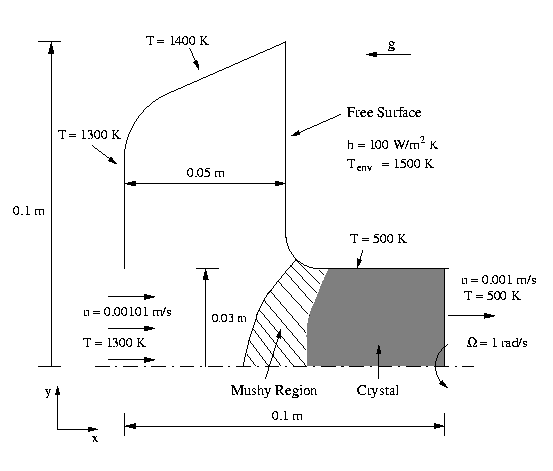
This tutorial demonstrates the setup and solution procedure for a fluid flow and heat transfer problem involving solidification, namely the Czochralski growth process. The geometry considered is a 2D axisymmetric bowl (shown in Figure
22.1), containing liquid metal. The bottom and sides of the bowl are heated above the liquidus temperature, as is the free surface of the liquid. The liquid is solidified by heat loss from the crystal and the solid is pulled out of the domain at a rate of 0.001
 and a temperature of 500
 . There is a steady injection of liquid at the bottom of the bowl with a velocity of

 and a temperature of 1300
 . Material properties are listed in Figure
22.1.
. Material properties are listed in Figure
22.1.
Starting with an existing 2D mesh, the details regarding the setup and solution procedure for the solidification problem are presented. The steady conduction solution for this problem is computed as an initial condition. Then, the fluid flow is enabled to investigate the effect of natural and Marangoni convection in an transient fashion.
 |
= | 8000 - 0.1
 T T
 |
 |
= | 5.53
 10 10

 |
| k | = | 30
 |
 |
= | 680
 |
 |
= | -3.6
 10 10

 |
 |
= | 1100
 |
 |
= | 1200
 |
| L | = | 1
 10 10

 |
 |
= | 1
 10 10

 |
Previous:
Prerequisites