![[ANSYS, Inc. Logo]](fluentlogo.gif)


|
|
|
For gas-phase reactions, the reaction rate is defined on a volumetric basis and the rate of creation and destruction of chemical species becomes a source term in the species conservation equations. For surface reactions, the rate of adsorption and desorption is governed by both chemical kinetics and diffusion to and from the surface. Wall surface reactions thus create sources and sinks of chemical species in the gas phase, as well as on the reacting surface.
Theoretical information about wall surface reactions and chemical vapor deposition is presented in this section. For more information about using wall surface reactions and chemical vapor deposition, see this section in the separate User's Guide.
Consider the
 th wall surface reaction written in general form as follows:
where
 ,
,
 , and
, and
 represent the gas phase species, the bulk (or solid) species, and the surface-adsorbed (or site) species, respectively.
 ,
,
 , and
, and
 are the total numbers of these species.
 ,
,
 , and
, and
 are the stoichiometric coefficients for each reactant species
 , and
, and
 ,
,
 , and
, and
 are the stoichiometric coefficients for each product species
 .
.
 is the overall forward reaction rate constant. Note that
ANSYS FLUENT cannot model reversible surface reactions.
is the overall forward reaction rate constant. Note that
ANSYS FLUENT cannot model reversible surface reactions.
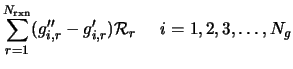
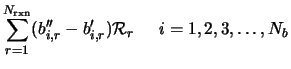
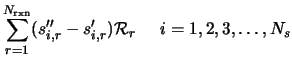
The summations in Equation 7.2-1 are for all chemical species in the system, but only species involved as reactants or products will have non-zero stoichiometric coefficients. Hence, species that are not involved will drop out of the equation.
The rate of the
 th reaction is
where
![$\left[\;\;\right]_{\rm wall}$](img3221.gif) represents molar concentrations of surface-adsorbed species on the wall.
represents molar concentrations of surface-adsorbed species on the wall.
 is the rate exponent for the
 gaseous species as reactant in the reaction and
 is the rate exponent for the
 site species as reactant in the reaction. It is assumed that the reaction rate does not depend on concentrations of the bulk (solid) species. From this, the net molar rate of production or consumption of each species
 is given by
The forward rate constant for reaction
 (
(
 ) is computed using the Arrhenius expression,
| where |
 |
= | pre-exponential factor (consistent units) |
 |
= | temperature exponent (dimensionless) | |
 |
= | activation energy for the reaction (J/kgmol) | |
 |
= | universal gas constant (J/kgmol-K) |
You (or the database) will provide values for
 ,
,
 ,
,
 ,
,
 ,
,
 ,
,
 ,
,
 ,
,
 , and
, and
 .
.
To include the mass transfer effects and model heat release, refer to this section , this section , and this section in the separate User's Guide
Previous:
7.1.2 The Generalized Finite-Rate

![{\cal R}_r = k_{f,r} \left(\prod_{i=1}^{N_g} \left[C_i\righ... ...j=1}^{N_s}\left[S_j\right]_{\rm wall}^{{\eta}'_{j,s,r}}\right)](img3220.gif)