![[ANSYS, Inc. Logo]](fluentlogo.gif)


|
|
|
The evaporation-condensation model is a mechanistic model [ 185], with a physical basis. It is available with the mixture and Eulerian multiphase models.
Based on the following temperature regimes, the mass transfer can be described as follows:
If

 |
(16.7-40) |
If

 represents the rate of mass transfer from the liquid phase to the vapor phase, with units of
 .
.
 is a coefficient that needs to be fine tuned and can be interpreted as a relaxation time.
 and
and
 are the phase volume fraction and density, respectively. The source term for the energy equation can be obtained by multiplying the rate of mass transfer by the latent heat.
Consider the Hertz Knudsen formula, which gives the evaporation-condensation flux based on the kinetic theory for a flat interface:
 |
(16.7-42) |
The flux has units of
 ,
,
 is the pressure,
 is the temperature, and
 is the universal gas constant. The coefficient
 is the so-called accommodation coefficient that shows the portion of vapor molecules going into the liquid surface and adsorbed by this surface.
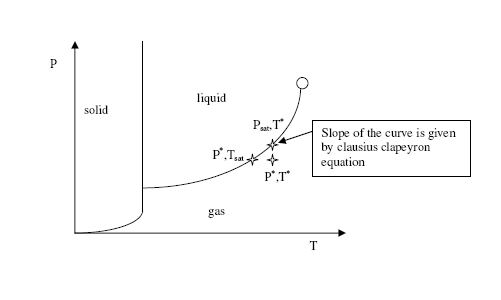
 represents the vapor partial pressure at the interface on the gas side. The Clapeyron-Clausius equation relates the pressure to the temperature for the saturation condition. (It is obtained by equating the vapor and liquid chemical potentials):
 |
(16.7-43) |
 and
and
 are the inverse of the density for the gas and liquid (volume per mass unit), respectively.
 is the latent heat (J/kg).
Based on this differential expression, we can obtain variation of temperature from variation of pressure close to the saturation condition.
The Clausius Clapeyron equation yields the following formula as long as
 and
and
 are close to the saturation condition:
 |
(16.7-44) |
Using this relation in the above Hertz Knudsen equation yields [ 346]
 |
(16.7-45) |
The factor
 is defined by means of the accomodation coefficient and the physical characteristics of the gas.
 approaches 1.0 at near equilibrium conditions.
In the Eulerian and mixture multiphase models, the flow regime is assumed to be dispersed. If we assume that all vapor bubbles, for example, have the same diameter, then the interfacial area density is given by the following formula:
 |
(16.7-46) |
where
 is the cell volume and the phase source term (
 ) should be of the form:
![F \frac{A_i}{V_{cell}} = \frac{6}{d}\beta \sqrt{\frac{M}{2 \... ...)\left[ \rho_g \alpha_v \frac{(T^* - T_{sat}}{T_{sat}}\right]](img8147.gif) |
(16.7-47) |
From the above equation,
 , which is the inverse of the relaxation time (1/s) is defined as
This leads to the final expression for the vaporization, defined in Equation 16.7-41. It can be treated implicitly as a source term in the phase conservation equation.
A similar expression can be obtained for condensation. In this case, we consider small droplets in a continuous vapor phase even if your primary phase is a liquid.
Note that the coefficient
 should theoretically be different for the condensation and evaporation expression. Furthermore, the theoretical expression is based on a few strong assumptions:

The bubble diameter and accommodation coefficient are usually not very well known, which is why the coefficient
 can be fine tuned to match experimental data. By default, the coefficient for both evaporation and condensation is 0.1.
Previous:
16.7.4 Cavitation Models