![[ANSYS, Inc. Logo]](fluentlogo.gif)


|
|
|
Given a set of moments, the most likely PSD can be obtained based on the "statistically most probable'' distribution for turbulent flames [ 23], which was adapted for crystallization problems by Baldyga and Orciuch [ 3].
The number density function
 is expressed as
 |
(2.4-1) |
The equation for the
 th moment is now written as
 |
(2.4-2) |
Given
 moments, the coefficients
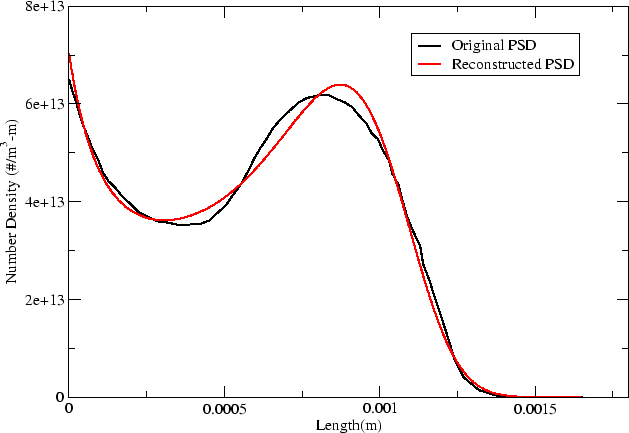
 can be found by a globally convergent Newton-Raphson method to reconstruct the particle size distribution (e.g., Figure
2.4.1).
can be found by a globally convergent Newton-Raphson method to reconstruct the particle size distribution (e.g., Figure
2.4.1).
Previous:
2.3.3 The Quadrature Method