![[ANSYS, Inc. Logo]](fluentlogo.gif)


|
|
|
The radiative transfer equation (RTE) for an absorbing, emitting, and scattering medium at position
 in the direction
 is
is
| where |
 |
= | position vector |
 |
= | direction vector | |
 |
= | scattering direction vector | |
 |
= | path length | |
 |
= | absorption coefficient | |
 |
= | refractive index | |
 |
= | scattering coefficient | |
 |
= | Stefan-Boltzmann constant (5.669
 10 10
 W/m W/m
 -K -K
 ) ) | |
 |
= | radiation intensity, which depends on position (
 and direction and direction
 | |
 |
= | local temperature | |
 |
= | phase function | |
 |
= | solid angle |
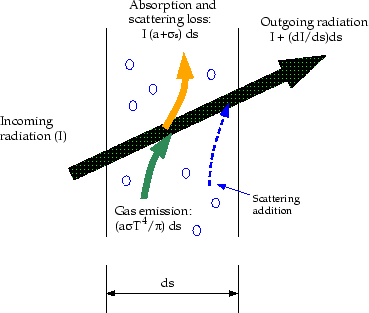
 is the optical thickness or opacity of the medium. The refractive index
 is important when considering radiation in semi-transparent media. Figure
5.3.1 illustrates the process of radiative heat transfer.
is important when considering radiation in semi-transparent media. Figure
5.3.1 illustrates the process of radiative heat transfer.
The DTRM and the P-1, Rosseland, and DO radiation models require the absorption coefficient
 as input.
 and the scattering coefficient
 can be constants, and
 can also be a function of local concentrations of H
 O and CO
 , path length, and total pressure.
ANSYS FLUENT provides the weighted-sum-of-gray-gases model (WSGGM) for computation of a variable absorption coefficient.
See Section
5.3.8 for details. The discrete ordinates implementation can model radiation in semi-transparent media. The refractive index
, path length, and total pressure.
ANSYS FLUENT provides the weighted-sum-of-gray-gases model (WSGGM) for computation of a variable absorption coefficient.
See Section
5.3.8 for details. The discrete ordinates implementation can model radiation in semi-transparent media. The refractive index
 of the medium must be provided as a part of the calculation for this type of problem. The Rosseland model also requires you to enter a refractive index, or use the default value of
 .
.
Previous:
5.3.1 Overview and Limitations