![[ANSYS, Inc. Logo]](fluentlogo.gif)


|
|
|
The SMM, proposed by Randolph and Larson [ 26] is an alternative method for solving the PBE. Its advantages are that it reduces the dimensionality of the problem and that it is relatively simple to solve transport equations for lower-order moments. The disadvantages are that exact closure of the right-hand side is possible only in cases of constant aggregation and size-independent growth, and that breakage modeling is not possible. The closure constraint is overcome, however, through QMOM (see Section 2.3.3).
Numerical Method
The SMM approach is based on taking moments of the PBE with respect to the internal coordinate (in this case, the particle size
 ).
).
Defining the
 th moment as
 |
(2.3-18) |
and assuming constant particle growth, its transport equation can be written as
where
 is the specified number of moments and
 is the nucleation rate. The growth term is defined as
and for constant growth is represented as
 |
(2.3-25) |
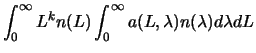
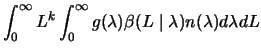
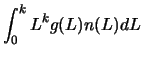
Equation 2.3-20 can be derived by using

and reversing the order of integration. From these moments, the parameters describing the gross properties of particle population can be derived as
 , is usually used as the mean particle size.
To close Equation
2.3-19, the quantities represented in Equations
2.3-20-
2.3-23 need to be expressed in terms of the moments being solved. To do this, one approach is to assume size-independent kernels for breakage and aggregation, in addition to other simplifications such as the Taylor series expansion of the term
 . Alternatively, a profile of the PSD could be assumed so that Equations
2.3-20-
2.3-23 can be integrated and expressed in terms of the moments being solved.
. Alternatively, a profile of the PSD could be assumed so that Equations
2.3-20-
2.3-23 can be integrated and expressed in terms of the moments being solved.
In ANSYS FLUENT, an exact closure is implemented by restricting the application of the SMM to cases with size-independent growth and a constant aggregation kernel.
Previous:
2.3.1 The Discrete Method