![[ANSYS, Inc. Logo]](fluentlogo.gif)


|
|
|
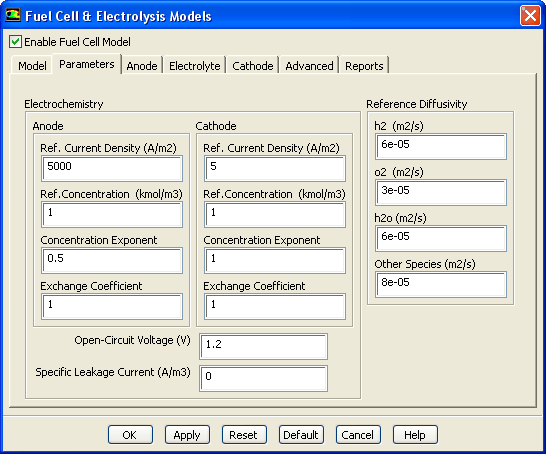
You can use the Parameters tab of the Fuel Cell and Electrolysis Models dialog to specify the electrochemistry parameters for the Fuel Cell and Electrolysis Model, reference diffusivities for the reactants, among other model parameters.
There are various parameters under Electrochemistry in the Fuel Cell and Electrolysis Models dialog. For both the anode and the cathode, you can also set the following parameters or leave the default values.
 and
and
 , the reference exchange current density from Equation
1.2-3 and Equation
1.2-4.
, the reference exchange current density from Equation
1.2-3 and Equation
1.2-4.
![$ [H_2]_{\rm ref}$](img268.gif) and
and
![$[O_2]_{\rm ref}$](img269.gif) ) with units of 1 kgmol/m
) with units of 1 kgmol/m
 (see Equation
1.2-3 and Equation
1.2-4).
(see Equation
1.2-3 and Equation
1.2-4).
 , the concentration dependence from Equation
1.2-3.
, the concentration dependence from Equation
1.2-3.
 , the transfer coefficient from Equation
1.2-3.
, the transfer coefficient from Equation
1.2-3.
 in Equation
1.2-8.
in Equation
1.2-8.
 in Equations
1.8-1 through
1.8-6. This is the total amount of transfer current (A
in Equations
1.8-1 through
1.8-6. This is the total amount of transfer current (A
 ) due to fuel oxidant cross-over (leakage through the electrolyte). When this happens, the fuel cell generates less current especially for cases with low values of fuel or air utilization. In addition to the constant value you can specify in the
Electrochemistry tab, you can also specify the specific leakage current through the user-defined function
Leakge_Current(). For more information, see Section
2.11.
) due to fuel oxidant cross-over (leakage through the electrolyte). When this happens, the fuel cell generates less current especially for cases with low values of fuel or air utilization. In addition to the constant value you can specify in the
Electrochemistry tab, you can also specify the specific leakage current through the user-defined function
Leakge_Current(). For more information, see Section
2.11. Moreover, the following parameters can also be set here:
 from Equation
1.6-1, the species mass diffusivity. These are not be required if the
Multicomponent Diffusion option is enabled in the
Model tab.
from Equation
1.6-1, the species mass diffusivity. These are not be required if the
Multicomponent Diffusion option is enabled in the
Model tab.
 from Equation
1.6-1 for multiphase PEMFC calculations.
from Equation
1.6-1 for multiphase PEMFC calculations.
Previous:
2.6.1 Specifying Model Options